On December 16, 131 anti-war protesters were arrested outside the White House, while calling for an immediate end to the wars in Afghanistan and Iraq. The protesters—which included notable activist, Daniel Ellsberg and author Chris Hedges, as well as regional members of Veterans for Peace—chained themselves to the White House fence, before police officers (literally) dragged them away. According to a recent email notice from Veterans for Peace, the charges of trespassing and failing to obey officers’ orders to vacate the premises were all dropped.
If this is the first you have heard about this major arrest, you are likely not alone. The protest received next to no coverage in the corporate, Tea Party-obsessed media. However, the event serves as another example of how fed up Americans have become of the on-going wars in the Middle East.
A recent CNN poll reveals 63 percent of Americans believe the U.S. should end the Afghanistan war. Another poll by 60 Minutes and Vanity Fair finds 20 percent of respondents would reduce the national deficit by slashing the bloated military-spending budget. (The survey also shows majority support—61 percent—for raising taxes on the wealthy.)
It may have taken ten years, but it seems Americans have finally soured on the ill-conceived and undefined Afghanistan war—a conflict initiated by President Bush immediately after the 2001 terrorist attack, and expanded by President Obama. Meanwhile, U.S. soldiers remain an occupying force in Iraq, despite many Americans’ erroneous belief that war has ended.
Yet, despite the growing opposition to these military endeavors, President Obama recently announced an additional 1,400 troops will be sent to Afghanistan. Once again, the warmongers in Washington have made it clear they do not particularly care what American citizens want.
According to author and progressive activist David Swanson, this discrepancy between the aims of militaristic lawmakers and the people is, unfortunately, nothing new. As he argues in his recent book, War Is a Lie, this has been the case for every major military conflict in our nation’s history.
“Not a single thing we commonly believe about wars that helps keep them around is true,” Swanson begins the book. “Wars cannot be good or glorious. Nor can they be justified as a means of achieving peace, or anything else of value. The reasons given for wars before, during and after them…are all false.”
Swanson, a blogger for After Downing Street.org (now renamed War Is a Crime.org), then proceeds to debunk the supposedly noble and altruistic motives behind every major U.S. war in history—including such revered “good wars” as the Revolutionary War and World War II. According to Swanson, all of these wars have been based on misleading or distorted evidence, fabrications of intelligence, or outright lies and propaganda. War Is a Lie examines how presidents and the media have routinely used such lies to sell the public on wars they otherwise would have no legitimate interest in fighting in—let alone dying for.
With a historian’s precision, Swanson unmasks the lies about the Gulf of Tonkin incident that launched the Vietnam War; the seldom acknowledged fact that the United States had quietly provoked the Japanese to attack Pearl Harbor prior to WW II; the propaganda of slain Kuwaiti infants that lead to the first Gulf War; and how the bloody Civil War was only later recast by President Lincoln as a battle to end slavery. Finally, he turns to our two current military conflicts in Iraq and Afghanistan and the respective lies concerning WMD and the Sept. 11, 2001 counter-attack (the 9/11 hijackers primarily hailed from Saudi Arabia, not Afghanistan) used to sell those wars.
Swanson also tackles oft-repeated media assessments claiming the U.S. “won” in Iraq, or that George W. Bush’s “surge” of troops in that country “succeeded.” He likewise examines the hypocrisy of “anti-war” representatives and senators who consistently vote for additional war-funding bills in Congress (as Barack Obama repeatedly did while in the Senate, even though he claimed to oppose the Iraq War).
Like media critic Norman Solomon’s similarly-themed, War Made Easy: How Presidents and Pundits Keep Spinning us to Death, War Is a Lie counters the pervasive (and ludicrous) myth that war is always reserved as a last resort, or that our leaders simply had “no other choice.” As Swanson reveals, it is often quite the reverse: Due to corporate interests, the vast influence of the military-industrial-complex and an unquenchable thirst for finite natural resources, war is typically the first and only option government leaders consider.
Arguing against the unassailable necessity of World War II, Swanson observes the battle, “was not fought to save the Jews, and it did not save them. Refugees were turned away and abandoned. Plans to ship Jews out of Germany were frustrated by Britain’s blockade… It was not fought against racism by a nation imprisoning Japanese-Americans and segregating African American soldiers. It was not fought against imperialism by the world’s leading and most up-and-coming imperialists.”
He continues, “Obama claims his only choices are war or nothing. But the reason people know the names Gandhi…and King is that they suggested other options and proved that those other approaches could work.”
With the looming budget wars in the new Republican-led Congress, anti-war activists may finally have the necessary momentum to push for an end to the needless spending in Afghanistan and Iraq. Not, of course, that we should expect the Republicans to suddenly become pacifists. But Swanson’s book serves as a crucial reminder of the civic duty we all have as citizens to do everything within our power to end these immoral, unjust wars.
“War is a meme,” he writes, “a contagious idea that serves its own ends. War excitement keeps war alive. It does no good for human beings.”
More GRITtv
Sunday, January 9, 2011

Saturday, December 11, 2010
Pentagon Papers Redux
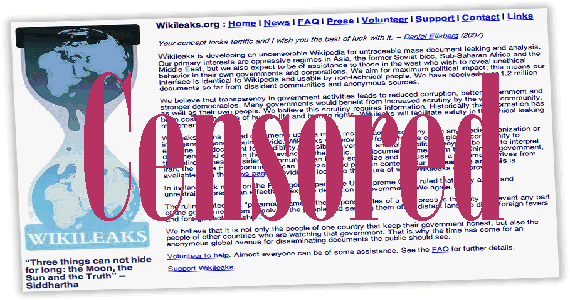
The other day, I voted in a Time magazine online poll for Julian Assange as my choice for the magazine’s annual “Person of the Year.” (He’s currently in the lead. The other nominees are predictably boring: Lady Gaga, Glen Beck, Stewart and Colbert and that damn Facebook creator.)
Time’s brief blurb calls Assange, “a new kind of whistle-blower: One made for the digital age.”
The WikiLeaks.org co-founder is currently being held in British custody, having turned himself in for questioning regarding allegations of rape and sexual misconduct by two Swedish women. There is now speculation the U.S. government will attempt to extradite him, and try him under the Espionage Act for his website’s recent disclosure of over 250,000 classified U.S. military documents.
Of course, White House officials and elite opinion makers wasted no time in denouncing WikiLeaks’ actions. Upon hearing of Assange’s arrest, Secretary of Defense Robert M. Gates quipped, “Sounds like good news to me.”
The more extreme members of the Right ratcheted the rhetoric even further. Incoming Republican Congressman Peter King wants WikiLeaks to be designated a “terrorist organization,” while Fox News host, Bob Beckel has called for Assange’s assassination.
For his own part, Assange describes himself as a journalist. He told Democracy Now! host Amy Goodman earlier this summer, “We have clearly stated motives, but they are not anti-war motives… We are transparency activists who understand that transparent government tends to produce just government.” (Democracy Now!, July 28, 2010.)
The attacks on Assange are hardly surprising. This tactic of shooting the messenger, while ignoring the message is the same one conservatives employ on the issue of global-warming. (The Right lodges personal attacks against Al Gore, for instance, yet ignore all the science, facts and empirical evidence of his warnings on climate-change.)
As Congressman Ron Paul points out in a recent radio message to supporters, “At its core, the WikiLeaks controversy serves as a diversion from what our foreign policy should be. But the mainstream media, along with neoconservatives in both parties insists on asking the wrong questions. When presented with embarrassing disclosures about U.S. spying and meddling, the policy that requires so much spying and meddling is not questioned.”
Indeed, it seems Americans should be more upset about the recent disclosures of covert U.S. activity WikiLeaks has disclosed—including the U.S. military’s pressure on Iraqi soldiers to cover-up instances of torture during the Iraq war. Instead, the media focuses exclusively on Assange himself, painting him as a sort of cyber-terrorist, and recklessly endangering U.S. military endeavors. Consider the irony of the Obama administration’s Justice Department drafting a criminal case against Assange and WikiLeaks, while it has to date refused to bring similar charges against members of the previous administration for authorizing torture and other heinous, un-constitutional crimes.
According to Daniel Ellsberg, the media launched the same sort of attack on him when he leaked the Pentagon Papers to the press some forty years ago. (If Ellsberg was never publicly called a “terrorist” at the time, it was only because the post-9/11 derogatory term was not as thoroughly embedded in the political vernacular as it is today.)
Ellsberg was a military analyst for the RAND Corporation during the height of the Vietnam War. When an epiphany of anti-war sentiment caused him to re-think his involvement in the war, Ellsberg stole the massive collection of classified CIA documents chronicling the United States’ Vietnam War plans known as the “Pentagon Papers” and sent them to the New York Times.
(Ellsberg’s story was recently chronicled in Judith Ehrlich and Rick Goldsmith’s superb documentary, The Most Dangerous Man in America.)
The Pentagon Papers detailed, amongst other revelatory insights that the United States’ Vietnam policy had been in place as early as 1945. The documents’ authors were also surprisingly candid in their bleak assessment of the prospects for military success in Vietnam. One chart, drafted long after the war was underway, conceded U.S. persistence in Vietnam was driven:
“70 percent to avoid a humiliating defeat.
- 20 percent to prevent South Vietnam from [falling into] Chinese hands.
- 10 percent to help the [people of South Vietnam] to enjoy a better, freer way of life.”
The writers went out of their way to note the war was not being fought to “help a friend.”
The New York Times began publishing the documents on June 13, 1971. In retaliation, the Nixon administration sued the Times, insisting the paper cease publication of the documents immediately. The case was taken up by the Supreme Court shortly thereafter.
In the ensuing legal battle, “New York Times Co. v. U.S. Government (403 U.S. 713),” the Court ruled 6-3 in favor of the Times and Ellsberg. The Court deemed the Nixon White House had failed to meet the heavy “burden of proof” to demonstrate the disclosure of the Pentagon Papers had caused a significant threat to security. (The case is considered one of the hallmark First Amendment decisions, intricately linked with freedom of the press.)
In his passionate majority opinion statement, Justice Hugo Black wrote:
“I believe that every moment’s continuance of the injunctions against these newspapers amounts to a flagrant, indefensible, and continuing violation of the First Amendment… Both the history and language of the First Amendment support the view that the press must be left free to publish news, whatever the source, without censorship, injunctions, or prior restraints.”
Justice Potter Stewart concurred, adding, “In absence of governmental checks and balances, the only effective restraint upon executive policy and power may lie in an enlightened citizenry—in an informed and critical public opinion which alone can here protect the values of democratic government.”
It should come as little surprise then, that Ellsberg has emerged as one of the strongest supporters of both Assange and the imprisoned PFC Bradley Manning—widely believed to be the original source of WikiLeaks’ extensive military files.
Regardless of what one personally thinks of Julian Assange’s actions, there is little doubt he has done more to promote freedom of information, freedom of the press and democracy than anybody else on Time’s “People of the Year” list. And for that reason alone he deserves both our praise and support.
Wednesday, December 8, 2010
Slouching Towards Oblivion

Why the Internet will not save newspapers.
On my way to the local convenience store the other day to grab my daily copy of the New York Times, I was disappointed to find the owner has discontinued his newspaper sales. He became fed up, he explained to me, with the unreliable delivery service, which was often late, or left the newspapers outside in the pouring rain.
Mostly though, he was tired of being left with too many papers at the end of the day. Nobody—other than me, he pointed out sardonically—was buying them.
Such seems to be the unfortunate case for newspapers nationwide. The displacement of physical newspapers by the Internet, a major loss of advertising dollars at national and local papers, and a general lack of interest among young, digitally-oriented readers all seem to have combined to sound the death knell for the newspaper industry.
Authors John Nichols and Robert McChesney in their book The Death and Life of American Journalism are blunt in their assessment of the situation. “Newspapers, as we have known them, are disintegrating and are possibly on the verge of extinction,” they state in the first chapter. “Media corporations,” the authors continue, “after running journalism into the ground, have determined that news gathering and reporting are not profit-making propositions. So they’re jumping ship.”
The depressing numbers bear this out. Last year, the Los Angeles Times cut 300 editorial and staff writer jobs. The Miami Herald cut 205; The Atlanta Journal-Constitution, 156; Kansas City Star, 150; Sacramento Bee, 128 and 100 jobs were cut at the Providence Journal in Rhode Island.
Meanwhile, larger newspapers like the Chicago Tribune, the Minneapolis Star Tribune and the Philadelphia Inquirer have filed for bankruptcy. And the owners of the San Francisco Chronicle are losing $1 million a week. They have threatened to shut the paper down.
Times’ columnist, Maureen Dowd sums up newspapers’ predicament in an Op-Ed titled, “Slouching Towards Oblivion.” (New York Times, April 25, 2009)
“Now that everybody can check their iPhones and laptops for news that personally interests them,” Dowd writes, “now that they can Google, blog and tweet… old-school newspapers seem like aging silent film stars, stricken to find themselves outmoded by technology.”
While conventional wisdom suggests news will simply migrate online, and that we should not mourn the loss of “antiques” like newspapers, the prospects for original, quality journalism surviving (never mind thriving) online remain dubious. As usual, there are a number of factors most who favor the conversion of news to the Internet have neglected to consider.
When it comes to the print vs. digital debate, it is worth keeping in mind Marshall McLuhan’s famous aphorism that, “The medium is the message.”
The celebrated media scholar and theorist first made this observation in 1964’s Understanding Media: The Extensions of Man. There he argues it is the medium itself—not its content—that deserves attention. In other words, it is the new environments and societal changes a new medium or technology (print, radio, television, etc.) brings about that is significant. The medium’s particular content or “message,” McLuhan argues, is irrelevant.
He writes:
“…the ‘message’ of any medium or technology is the change of scale or pace or pattern that it introduces into human affairs. The railway did not introduce movement or transportation or wheel or road into human society, but it accelerated and enlarged the scale of previous human functions, creating totally new kinds of cities and new kinds of work and leisure. This happened whether the railway functioned in a tropical or a northern environment, and it is quite independent of the freight or content of the railway medium.”
(With regard to a medium’s content, McLuhan famously proclaimed it made little difference if television networks aired educational programs or violent broadcasts. TV’s overall societal effect, he believed, would largely remain the same. “In terms of the ways in which the machine altered our relations to one another and to ourselves,” McLuhan states in Understanding Media, “it mattered not in the least whether it turned our cornflakes or Cadillacs.”)
The Internet, then, is no different. Indeed, it has already been established we do not read online content the same way we would a book or newspaper article. In general, online users do not read text for comprehension so much as they rapidly scan it for information. According to a study by usability expert, Jakob Nielsen, the eye actually moves across a computer screen differently than it does a printed page—what Nielsen refers to as the “F-Shaped Pattern.”
(Nielsen also claims online readers are turned off by lengthy articles and long paragraphs of text, which may explain why this blog receives so few comments...)
An article in Slate on Nielsen’s findings (June 13, 2008) notes, “…given all the factors that can affect online reading, such as scrolling, font size, user expertise… Nielsen holds that on-screen reading is 25 percent slower than reading on paper.” In other words, if you truly want to understand that lengthy AP story on the latest WikiLeaks cable, you would be better off printing the article out and reading it.
This is, perhaps, the greatest loss in transferring news-print to the Internet: The loss of the time and patience necessary to truly understand the events and issues of the day. Short bursts of news online may give readers a basic idea of what happened. But it will not give them the whole story.
And that, I fear, is what will become of newspaper journalism if the industry is forced to migrate online.
As McLuhan presciently observed, “We shape our tools, and then our tools shape us.”
Artist Jenny Holzer brings poems of Szymborska to Portland

Last night, New York conceptual artist Jenny Holzer projected the poems of Wislawa Szymborska onto the surface of the Portland Museum of Art, on Congress Street. Holzer has traveled around the world doing just this, using various brick building landscapes as her canvas for showcasing works of social justice. She titled last night's free poetry-projection event, "For Portland."
Szymborska is a Nobel-Prize winning poet from Poland, whose socially conscious work has frequently been adopted by peace and justice activists. Her poem "Torture" was one of the featured works projected onto the museum.
The poem reads as follows:
Torture by Wislawa Szymborska
Nothing has changed.
The body is painful,
it must eat, breathe air and sleep,
it has thin skin, with blood right beneath,
it has a goodly supply of teeth and nails
its bones are brittle, its joints extensible.
In torture, all this is taken into account.
Nothing has changed.
The body trembles, as it trembled
before and after the founding of Rome,
in the twentieth century before and after Christ. Torture is, as it's always been, only the earth has shrunk, and whatever happens, feels like it happens next door.
Nothing has changed. Only there are more people,
next to old transgressions, new ones have appeared
real, alleged, momentary, none,
but the scream, the body's response to them-- was, is, and always will be the scream of innocence, in accord with the age-old scale and register.
Nothing has changed.
Except maybe manners, ceremonies, dances.
Yet the gesture of arms shielding the head
has remained the same.
The body writhes, struggles, and tries to break away.
Bowled over, it falls, pulls in its knees,
bruises, swells, drools, and bleeds.
Nothing has changed.
Except for the courses of rivers,
the contours of forests, seashores, deserts and icebergs.
Among these landscapes the poor soul winds,
vanishes, returns, approaches, recedes.
A stranger to itself, evasive,
at one moment sure, the next unsure of its existence,
while the body is and is and is
and has no place to go.
Monday, November 8, 2010
Big Government, Bigger Hypocrites
I don’t know about you, but I am sick to death of hearing about “Big Government.”
If we are to believe the Tea Party Republicans that were swept into power last week, President Obama and the outgoing Democratic Congress have significantly increased the size and scope of the federal government. Republicans are claiming their win Tuesday was a response from American voters against this “Big Government” takeover.
60 Minutes correspondent, Steve Kroft addressed this increased government argument in his interview with President Obama last night.
“The Republicans say the voters sent you a very clear message,” Kroft opened his interview, “that they want a smaller, less costly, more accountable government.”
Obama answered that Americans are understandably upset about “debts and deficits.” “I think that is absolutely a priority,” the president responded.
Yet, is the concept of “Big Government” really limited to only the federal debt and taxes?
Indeed, it seems conservatives hold a very narrow definition of so-called “Big Government.” When those on the Right invoke the specter of “Big Government,” they are generally referring to higher (or, at least the perception of higher) taxes and government spending. While these two issues make for effective Republican talking points, this narrow concept of Big Government ignores other far more chilling hallmarks of the phrase.
“We have always had Big Government in this country,” late historian Howard Zinn explained in a 2008 interview with the online, Real News Network (Oct. 23, 2008). “With a few exceptions… the government has always been in the service of the wealthy classes.”
So if we are to talk about Big Government, let us be all inclusive in our definition of the term.
Torture, extraordinary rendition and detention without due process are all classic hallmarks of Big Government. However, these horrific practices are not included in the Republicans’ definition of oversized government. And maintaining a “more accountable government” would require the U.S. to prosecute members of the previous administration for authorizing the use of torture in the first place. Again, one hears no calls from members of the Tea Party for such criminal accountability.
Government spying and warrantless wiretapping programs are also an aspect of Big Government. Under the guise of the “war on terror,” the Bush administration secretly (and illegally) monitored the emails and phone conversations of hundreds of citizens—often based on only the slightest evidence or suspicion. Indeed, it is difficult to find a more glaring example of the federal government literally intruding on the lives and private affairs of its citizens. Yet, Republicans were suspiciously silent when news of this clandestine program first broke in 2005.
Finally, a pre-emptive war based on lies and deliberate falsification of evidence (like the Iraq war) is perhaps the most frightening form of Big Government. But it was Republican President George W. Bush who used lies and propaganda to invade Iraq. For that matter, the United States’ long history of pre-emptive war and military dominance is never included in Republican accusations of Big Government.
“It’s interesting,” Zinn goes on, “when they say, ‘we must not have big government’ they don’t talk about the military, which is the biggest government of all.”
As Zinn observes, Big Government is not always necessarily a bad thing, either. He cites Social Security, the New Deal benefits and the GI Bill of Rights (which allowed him to pursue his PhD in history) as positive government-administered programs of social uplift.
“So forget about your argument against Big Government,” Zinn says. “It’s obvious we need Big Government.”
Well, we need more of the good kind, anyway. But let's not be so selective when talking about this idea of "Big Government."
If we are to believe the Tea Party Republicans that were swept into power last week, President Obama and the outgoing Democratic Congress have significantly increased the size and scope of the federal government. Republicans are claiming their win Tuesday was a response from American voters against this “Big Government” takeover.
60 Minutes correspondent, Steve Kroft addressed this increased government argument in his interview with President Obama last night.
“The Republicans say the voters sent you a very clear message,” Kroft opened his interview, “that they want a smaller, less costly, more accountable government.”
Obama answered that Americans are understandably upset about “debts and deficits.” “I think that is absolutely a priority,” the president responded.
Yet, is the concept of “Big Government” really limited to only the federal debt and taxes?
Indeed, it seems conservatives hold a very narrow definition of so-called “Big Government.” When those on the Right invoke the specter of “Big Government,” they are generally referring to higher (or, at least the perception of higher) taxes and government spending. While these two issues make for effective Republican talking points, this narrow concept of Big Government ignores other far more chilling hallmarks of the phrase.
“We have always had Big Government in this country,” late historian Howard Zinn explained in a 2008 interview with the online, Real News Network (Oct. 23, 2008). “With a few exceptions… the government has always been in the service of the wealthy classes.”
So if we are to talk about Big Government, let us be all inclusive in our definition of the term.
Torture, extraordinary rendition and detention without due process are all classic hallmarks of Big Government. However, these horrific practices are not included in the Republicans’ definition of oversized government. And maintaining a “more accountable government” would require the U.S. to prosecute members of the previous administration for authorizing the use of torture in the first place. Again, one hears no calls from members of the Tea Party for such criminal accountability.
Government spying and warrantless wiretapping programs are also an aspect of Big Government. Under the guise of the “war on terror,” the Bush administration secretly (and illegally) monitored the emails and phone conversations of hundreds of citizens—often based on only the slightest evidence or suspicion. Indeed, it is difficult to find a more glaring example of the federal government literally intruding on the lives and private affairs of its citizens. Yet, Republicans were suspiciously silent when news of this clandestine program first broke in 2005.
Finally, a pre-emptive war based on lies and deliberate falsification of evidence (like the Iraq war) is perhaps the most frightening form of Big Government. But it was Republican President George W. Bush who used lies and propaganda to invade Iraq. For that matter, the United States’ long history of pre-emptive war and military dominance is never included in Republican accusations of Big Government.
“It’s interesting,” Zinn goes on, “when they say, ‘we must not have big government’ they don’t talk about the military, which is the biggest government of all.”
As Zinn observes, Big Government is not always necessarily a bad thing, either. He cites Social Security, the New Deal benefits and the GI Bill of Rights (which allowed him to pursue his PhD in history) as positive government-administered programs of social uplift.
“So forget about your argument against Big Government,” Zinn says. “It’s obvious we need Big Government.”
Well, we need more of the good kind, anyway. But let's not be so selective when talking about this idea of "Big Government."
Friday, November 5, 2010
Mock the Vote
On a state and national level, college-aged voters decided to sit this election out.
Like many Maine voters, I am deeply disappointed by the election of Paul LePage as governor. Though most of Southern Maine went for Independent Eliot Cutler, the northern half of the state (including the small, rural towns of Houlton, Lubec, Presque Isle, Milford and my old stomping-grounds, Old Town) swayed the election in favor of the Tea Party Republican.
The election was, in many ways, reminiscent of last year’s state ballot vote on Maine’s gay-marriage bill, which also highlighted the striking differences between the northern and southern part of the state. As with that vote, the victory could have easily gone to progressives, if only more young people had bothered to go to the polls.
Though low youth voter turnout is nothing new or especially surprising during a midterm election, it is, nonetheless, difficult to reconcile in the wake of the record number of young, first-time voters who proved so crucial in Barack Obama’s election just two years ago. Indeed, at the time, much ink was spilled about the Millennial generation’s long overdue political “awakening.” Many reporters likened Obama to this generation’s JFK in terms of his charismatic appeal to young Americans.
Yet, according to a CBS News report, 18-29 year-olds comprised a measly 9% of overall voters in Tuesday’s midterm election. This number is down from 18% in the 2008 presidential election, the report notes.
Of those 18-29 year-olds who did vote, 58% supported Democratic candidates. Here in Maine however, many likely would have gone for Cutler, who drew a strong following of young supporters. Conversely, this age-group could have potentially strengthened Democrat Libby Mitchell’s overall performance, making her a more viable candidate. As it is, Mitchell gained an anemic 20% of the vote and bowed out of the race early in the evening.
According to a pre-election survey conducted by youth-voter-registration group, Rock the Vote, 77% of eligible young voters claimed they “definitely would cast ballots this year.” As DailyKos blogger, Meteor Blades laments, “Too bad that wasn’t the case. If it were, [Wisconsin Democrat and progressive champion] Russ Feingold would have another six-year term ahead of him.”
So what happened? Where were these young voters who were so energized and committed only two years ago? Unfortunately, when confronted about their intermittent and unreliable voting habits, many college-aged Americans fall back on the clichéd cop-out, “My one vote doesn’t count.”
“I just don’t feel like I have too much pull with my one vote,” Mallory Pie, a sophomore at Xavier University College told NYU’s student newspaper, Washington Square News. (Huffington Post, Nov. 3, 2010.)
While such a sentiment may have some merit in a national election (largely due to the constraints of the Electoral College), in Maine Cutler and LePage were only separated by one percentage point, or about 10,000 votes. Had Ms. Pie and, say twenty of her friends gone to the polls, collectively their votes could have made a difference. (OK, so I realize my math does not really add up here. In reality, she would need far more than twenty friends, and they all would have had to vote for Cutler. But you get my point.)
There are, of course, many additional factors that likely contributed to the low turnout.
For college students shielded from the current economic recession, the ominous reality of seemingly endless job-searches and rising unemployment rates may seem like distant and far-off obstacles. Additionally, the lack of a military draft all but ensured the wars in Afghanistan and Iraq were absent from most election debates. Of course, the fact that so few young people read newspapers or watch news on television regularly does not help matters. Instead, teenagers and college students spend an inordinate amount of time online—nearly eight hours a day according to a recent Kaiser Foundation report.
Finally, and perhaps most disheartening, many of Obama’s young supporters may already feel betrayed by his administration’s failure to bring about any of the progressive changes it promised. Certainly Mitchell had limited appeal amongst young voters, particularly Democrats who felt burned by outgoing Governor John Baldacci’s moderate policies. One liberal co-worker my age recently told me his disgust for Mitchell was so great he would rather see LePage elected governor than cast a vote for her. Looks like he got his wish. (He said he did not like Cutler, either.)
Yet one has to wonder: If today’s young people are still not politically engaged, when will they be? Do twenty-somethings really want the future of their state (or country) decided by a bunch of backward-thinking, semi-retired Baby Boomers, with little more than a high-school diploma to inform their choices? Are ironic, Comedy Central-sponsored pseudo rallies the only form of activism that moves this generation?
For such a privileged, tech-savvy generation that feels the need to announce to the world its every Twitter feed or Facebook update, when it comes to issues of true significance, too many young Americans choose to remain eerily silent.
Like many Maine voters, I am deeply disappointed by the election of Paul LePage as governor. Though most of Southern Maine went for Independent Eliot Cutler, the northern half of the state (including the small, rural towns of Houlton, Lubec, Presque Isle, Milford and my old stomping-grounds, Old Town) swayed the election in favor of the Tea Party Republican.
The election was, in many ways, reminiscent of last year’s state ballot vote on Maine’s gay-marriage bill, which also highlighted the striking differences between the northern and southern part of the state. As with that vote, the victory could have easily gone to progressives, if only more young people had bothered to go to the polls.
Though low youth voter turnout is nothing new or especially surprising during a midterm election, it is, nonetheless, difficult to reconcile in the wake of the record number of young, first-time voters who proved so crucial in Barack Obama’s election just two years ago. Indeed, at the time, much ink was spilled about the Millennial generation’s long overdue political “awakening.” Many reporters likened Obama to this generation’s JFK in terms of his charismatic appeal to young Americans.
Yet, according to a CBS News report, 18-29 year-olds comprised a measly 9% of overall voters in Tuesday’s midterm election. This number is down from 18% in the 2008 presidential election, the report notes.
Of those 18-29 year-olds who did vote, 58% supported Democratic candidates. Here in Maine however, many likely would have gone for Cutler, who drew a strong following of young supporters. Conversely, this age-group could have potentially strengthened Democrat Libby Mitchell’s overall performance, making her a more viable candidate. As it is, Mitchell gained an anemic 20% of the vote and bowed out of the race early in the evening.
According to a pre-election survey conducted by youth-voter-registration group, Rock the Vote, 77% of eligible young voters claimed they “definitely would cast ballots this year.” As DailyKos blogger, Meteor Blades laments, “Too bad that wasn’t the case. If it were, [Wisconsin Democrat and progressive champion] Russ Feingold would have another six-year term ahead of him.”
So what happened? Where were these young voters who were so energized and committed only two years ago? Unfortunately, when confronted about their intermittent and unreliable voting habits, many college-aged Americans fall back on the clichéd cop-out, “My one vote doesn’t count.”
“I just don’t feel like I have too much pull with my one vote,” Mallory Pie, a sophomore at Xavier University College told NYU’s student newspaper, Washington Square News. (Huffington Post, Nov. 3, 2010.)
While such a sentiment may have some merit in a national election (largely due to the constraints of the Electoral College), in Maine Cutler and LePage were only separated by one percentage point, or about 10,000 votes. Had Ms. Pie and, say twenty of her friends gone to the polls, collectively their votes could have made a difference. (OK, so I realize my math does not really add up here. In reality, she would need far more than twenty friends, and they all would have had to vote for Cutler. But you get my point.)
There are, of course, many additional factors that likely contributed to the low turnout.
For college students shielded from the current economic recession, the ominous reality of seemingly endless job-searches and rising unemployment rates may seem like distant and far-off obstacles. Additionally, the lack of a military draft all but ensured the wars in Afghanistan and Iraq were absent from most election debates. Of course, the fact that so few young people read newspapers or watch news on television regularly does not help matters. Instead, teenagers and college students spend an inordinate amount of time online—nearly eight hours a day according to a recent Kaiser Foundation report.
Finally, and perhaps most disheartening, many of Obama’s young supporters may already feel betrayed by his administration’s failure to bring about any of the progressive changes it promised. Certainly Mitchell had limited appeal amongst young voters, particularly Democrats who felt burned by outgoing Governor John Baldacci’s moderate policies. One liberal co-worker my age recently told me his disgust for Mitchell was so great he would rather see LePage elected governor than cast a vote for her. Looks like he got his wish. (He said he did not like Cutler, either.)
Yet one has to wonder: If today’s young people are still not politically engaged, when will they be? Do twenty-somethings really want the future of their state (or country) decided by a bunch of backward-thinking, semi-retired Baby Boomers, with little more than a high-school diploma to inform their choices? Are ironic, Comedy Central-sponsored pseudo rallies the only form of activism that moves this generation?
For such a privileged, tech-savvy generation that feels the need to announce to the world its every Twitter feed or Facebook update, when it comes to issues of true significance, too many young Americans choose to remain eerily silent.
Saturday, September 11, 2010
Nine Years Later...

While the excessive media coverage of right-wing reverend Terry Jones’ week-long threat to burn a collection of Korans with fellow hate-mongering Christian evangelicals at his Florida church has finally died down, what is missing, as usual, is some perspective on the matter.
Jones announced Thursday evening he had cancelled his proposed Koran-burning-day, scheduled to coincide with today’s nine-year observation of the September 11 terrorist attacks. Everyone from President Obama to Sarah Palin condemned Jones’ planned display of hatred and religious intolerance. (Palin continues to baffle by the day. She opposes the building of an Islamic mosque two blocks away from Ground Zero in New York City, yet came out against Jones as well. How is one form of religious intolerance different from the other?)
General David Petraeus, the U.S. commander of forces in Afghanistan, warned Jones earlier in the week his actions could further inflame anti-American sentiment throughout Arab nations—particularly towards U.S. soldiers in Afghanistan and Iraq. (As it turns out, Jones’ threatening to burn Korans alone has proven enough to enrage the Islamic world, as riots broke out throughout Afghanistan on Saturday.)
Yet it is not merely the burning of the Koran that has enraged Arab civilians. It is the burning of their homes, the bombing of their neighborhoods, and the indiscriminate killing of their children. Nine years after the September 11, 2001 terrorist attacks, the U.S. has escalated the military occupation of Afghanistan, yet made no significant progress toward dismantling al-Qaeda, or even finding Osama bin Laden.
(Incidentally, it’s interesting how seldom the media or the White House mentions bin Laden at this point. Even the Taliban leader’s ominous video messages—a consistently haunting staple of the Bush administration, particularly in the weeks before an election—seem to be a thing of the past. It begs the question: Does bin Laden even matter anymore?)
U.S. troops continue to occupy Iraq, despite the recent, misleading claims of military withdrawal. And now much of the war in Afghanistan is spilling over into Pakistan, where unmanned drones fire upon civilians in a manner more akin to a video game, than traditional military combat.
Yet these military acts of aggression are rarely factored into the on-going media analysis of “why they hate us.” As filmmaker Michael Moore notes in a recent blog post on his website (“Burn, Baby, Burn!” Sept. 9, 2010), “They hate us because we’ve killed hundreds of thousands of their people! We’ve claimed their oil as ours. Never ever forget that Saddam Hussein was armed and supported for years by THE UNITED STATES OF AMERICA. And WE overthrew the democratically-elected government of Iran. We continue to prop up the dictators of the Arabian peninsula and we have turned our backs on the Palestinian people.”
Unfortunately, many Americans remain ignorant of this history. Even in graduate school, I was often struck by how many of my colleagues (some of whom were pursuing doctoral degrees, mind you) knew almost nothing about the U.S.-backed overthrow of the Iranian government, for example.
In Eugene Jarecki’s 2005 documentary film, Why We Fight, author Chalmers Johnson explains the concept of “blowback,” a CIA-term for unintended consequences of U.S. covert military operations abroad. According to Johnson, because such retaliatory “blowback” is often in response to secret elements of American foreign policy (aspects typically ignored in high-school or even some college history classes), the public is “unable to put it in perspective.” This lack of historical knowledge makes it easier for presidents and pundits to claim events such as 9/11 occur because the perpetrators “hate us because of our freedoms.”
At one point in the film, another noted progressive author, Gore Vidal remarks, “We live in the United States of Amnesia. Every day is a blank… We have no history.”
Thus, it is not the burning of Korans that creates such anti-American hatred throughout the Middle East. The hostility is more likely due to our long, on-going history of war, occupation and imperialism in countries like Afghanistan, Iraq and Iran.
One particularly unnerving scene in Jarecki’s film features a graphic display highlighting countries that have been the target of U.S. military invasion throughout the twentieth century, while calendar years tick by on the right-hand bottom of the screen. As one year sequentially gives way to another, viewers are left with the startling realization that, since the end of World War II, America has spent most of the last 50 years at war (whether declared military combat, or covert intervention) somewhere throughout the globe.
This is, certainly, not to justify the horrific Sept. 11 attacks. Regardless of the terrorists’ motives, their actions killed 3,000 innocent people—Americans who played no role in the foreign policy decisions that lead the hijackers to launch such a grievous attack on our nation.
However, it is important to understand the 9/11 attacks did not come out of nowhere, devoid of historical context. The terrorists did not strike the United States out of some angry jealousy over our democratic liberties, or because Islam is an inherently “evil” religion that espouses anti-American terrorism.
They, unfortunately, had very real and legitimate grievances against U.S. hegemonic imperialism. Many Americans do not like to hear this. Indeed, some may feel such military actions were warranted, or perhaps they simply prefer to place an unquestioning, patriotic trust in whatever actions our government engages in, right or wrong. Yet, by refusing to understand the real, concrete reasons why 19 people felt threatened enough by America to hijack airplanes and fly them into heavily populated buildings, we simply invite further horrific attacks in the future.
Immediately after the Sept. 11 attacks, many Americans--spurred on by a militaristic government and subservient news media--felt a seething desire to respond to the attacks with military strength. However, forgiveness, reconciliation, and deep self-reflection often require even greater strength than declaring war. Nine years after the 9/11 attacks, let us hope it is not too late for Americans to summon the inner strength necessary to engage in these latter, largely un-attempted healing processes.
Subscribe to:
Posts (Atom)